GLOW 70 combines three of the most-studied regenerative research peptides in one vial: copper peptide GHK-Cu for collagen and skin-matrix research, with BPC-157 and TB-500 — the classic tissue-repair pairing from the preclinical literature.
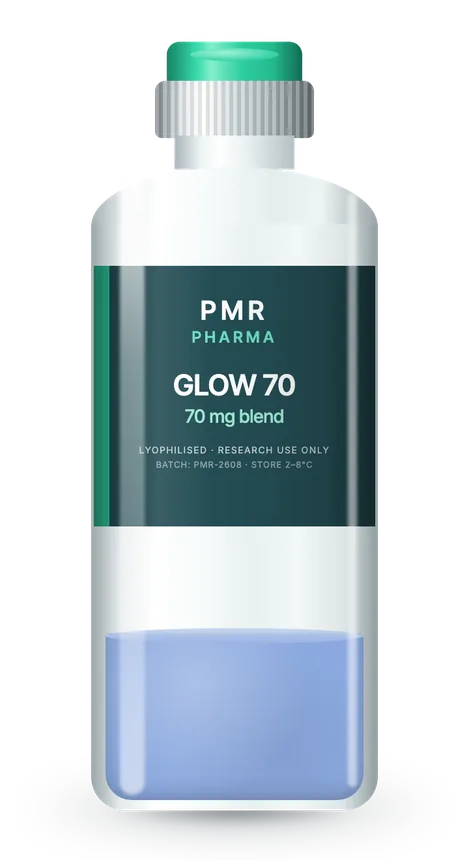
GLOW 70 is a co-lyophilised research blend built around GHK-Cu, the naturally occurring human copper peptide studied for collagen synthesis, skin remodelling and wound repair since the 1970s.
It is completed by BPC-157 and TB-500, two peptides with complementary repair mechanisms in animal studies — BPC-157 acting on blood-vessel formation and growth-factor pathways, TB-500 on the actin machinery that lets repair cells migrate to where they are needed.
The three compounds are individually well characterised in preclinical research; the blend exists as a convenience format for laboratories studying them together. No published studies test the three-way combination itself.
Findings from the published literature, with the evidence level stated honestly for every claim.
Studies suggest increased collagen, elastin and glycosaminoglycan synthesis by fibroblasts, with wound-repair effects in animal models.
In-vitro · animalAnimal studies suggest accelerated healing of tendon, ligament, muscle and gastrointestinal tissue via angiogenesis and nitric-oxide pathways.
AnimalPreclinical research suggests faster functional recovery and reduced scarring through actin-regulated cell migration.
Animal| Compound | GHK-Cu / BPC-157 / TB-500 co-lyophilised blend |
|---|---|
| Composition | GHK-Cu 50 mg · BPC-157 10 mg · TB-500 10 mg |
| Content | 70 mg total — lyophilised vial |
| Purity | ≥99% each component (HPLC) — batch COA supplied |
| Form | Lyophilised powder |
| Appearance | Blue-tinted powder (natural colour of the GHK-copper complex) |
| Storage | 2–8 °C lyophilised; reconstituted 2–8 °C |
Store lyophilised at 2–8 °C (or −20 °C long-term), protected from light. Reconstitute with bacteriostatic water and swirl gently — TB-500 is the most agitation-sensitive component. The blue colour comes from the GHK-copper complex and is a sign of an intact compound.
GHK-Cu is a copper complex and is naturally deep blue. A strong, even blue tint indicates the copper peptide is intact; colour loss suggests degradation.
Yes — the third-party certificate of analysis verifies the identity and ratio of all three components in the finished vial, not just the raw materials.
They are the three most-studied regenerative peptides in the preclinical literature, with complementary mechanisms — collagen synthesis (GHK-Cu), angiogenesis (BPC-157) and cell migration (TB-500). The blend is a convenience format for researchers studying them together.
Refrigerated at 2–8 °C. After reconstitution keep refrigerated and use within the research window stated on the COA.
Message us on WhatsApp for availability, batch COAs and dispatch. A real person replies — usually within the hour.
Enquire via WhatsApp