NAD+ is the coenzyme every living cell uses to move energy, and the obligatory fuel for the sirtuin and DNA-repair enzymes at the heart of ageing research. Its age-related decline is one of the most consistently replicated findings in the field.
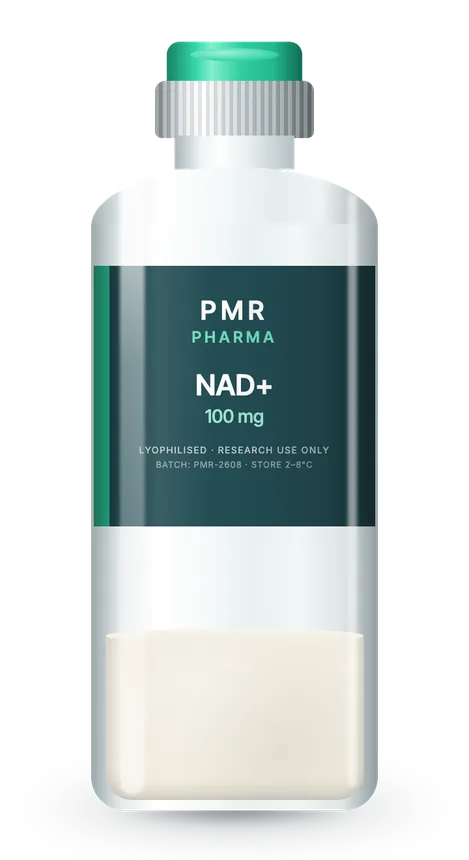
Nicotinamide adenine dinucleotide is textbook biochemistry: the primary electron carrier of cellular energy metabolism, cycling billions of times a day in every cell. It is not a peptide — it is a coenzyme, supplied here in the same research-vial format.
Beyond energy transfer, NAD+ is the required substrate for sirtuins (the enzyme family most associated with longevity research), PARPs (DNA repair) and CD38. That means NAD+ availability rate-limits some of the cell's most important maintenance machinery.
Tissue NAD+ levels decline with age — one of the most replicated biochemical hallmarks of ageing — which is the foundation of the entire NAD-restoration research field. Human trial evidence is strongest for precursor molecules; direct NAD+ administration remains an active research question.
Findings from the published literature, with the evidence level stated honestly for every claim.
First identified by Harden and Young as the 'cozymase' driving yeast fermentation — among the oldest known molecules in biochemistry.
HistoryNAD+ is the obligatory fuel for all seven sirtuin enzymes — the family at the centre of longevity research.
MechanismFalling tissue NAD+ with age is one of the most consistently replicated biochemical hallmarks of ageing.
Human · observational| Compound | β-Nicotinamide adenine dinucleotide (NAD+) |
|---|---|
| CAS number | 53-84-9 |
| Molecular weight | 663.4 Da |
| Content | 100 mg — lyophilised vial |
| Purity | ≥99% (HPLC) — batch COA supplied |
| Form | Lyophilised powder |
| Storage | −20 °C, sealed, protected from light and moisture |
NAD+ is more fragile than most compounds in the catalogue — hygroscopic and sensitive to heat, light and moisture. Store lyophilised at −20 °C, tightly sealed and protected from light. Reconstituted solution should be refrigerated and used promptly; a yellow tint indicates degradation.
No — it is a coenzyme, supplied in the same lyophilised research-vial format as our peptides. We label it accurately because precision matters in research supply.
It is the required substrate for sirtuins, PARP DNA-repair enzymes and CD38 — and its tissue levels decline consistently with age. That combination put it at the centre of the field.
More than most: heat, light, moisture and air all degrade it. Keep it frozen, sealed and dark until use, and watch for yellowing in solution.
Yes — independent third-party purity and identity testing per batch, COA matched to your vial's batch number.
Message us on WhatsApp for availability, batch COAs and dispatch. A real person replies — usually within the hour.
Enquire via WhatsApp